by Dr. Shlomo Kandelshine
”Hakoah” Vienna (SC Hakoah Wien) was a Jewish sports club founded in 1909 by Austrian Jewish Zionists, in the capital of Austria. The club, a leader in Europe at the time, was considered the largest Jewish sports club in the world until World War II. Its founders were the cabaret artist Fritz “Beda” Löhner and dentist Dr. Ings Hermann Korner.
Emblem of the Hakoah Vienna Sports Club
The club had sections in many sports, the most prominent of which was its magnificent football team, made up of outstanding Jewish football players from all over Europe, and the swimming section, which was also prominent. There were also sections for athletics, field hockey, wrestling, hiking, mountaineering, water polo, table tennis, fencing, chess, and more.
As part of the Vienna “Hakoah” club, the chess section also operated very successfully. Strong Jewish chess players played in this section, who also won Austrian championships, represented it in the Chess Olympiads, and played in international competitions.
In 1920, the football team qualified for the first league in Austria, going on to win the state championship in the 1924/1925 season. The team traveled extensively for friendly football matches around the world, visiting Israel twice in 1924 and 1925 for two matches with Maccabi Tel Aviv. In 1926, the team also played in New York against the “Ulm Storm” team, in front of a crowd of 46,000 spectators, and defeated the English team West Ham United in London.
The stars of the team were Bela Guttmann, one of the greatest footballers (a player for the Hungarian national team) and coaches in history (coaching Milan, Benfica, São Paulo, Porto, Panathinaikos and the Austrian national team, among others), as well as Egon Pollak and Leos Hess. The team was considered one of the best in Europe.
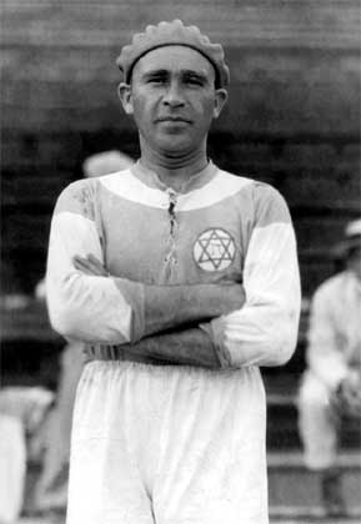
Legendary football player Bela Guttmann in the uniform of the Hakoah Vienna Team, 1925
Vienna, a center of chess “waltzes”
Vienna was a lively cultural center in general, and also a major chess center in Europe thanks to its strong chess clubs, one of the most prominent of which was the Jewish chess club “Hakoah” Vienna.
Among the Jewish chess players in Vienna were also chess giants of their time such as Reti and Spielmann, and other Jewish chess players also excelled, the most prominent of whom were:
Richard Reti, 1889-1929 – One of the greatest chess players in the world of his time, Austro-Hungarian and later Czech. Represented Czechoslovakia on the first board at the first Olympics in London in 1927. Mathematician who completed his studies at the University of Vienna, author of chess books, problems, and endings. The “Reti Opening” (1.Nf3 d5 2.c4) is named after him, with which he defeated World Champion Capablanca in the 1924 strong tournament in New York. Reti died of illness in 1929 at the age of 40 and was buried in Vienna.
Rudolf Spielman, 1883-1942 – Spielman won many international competitions, and twice defeated world champion Capablanca. He represented Austria at two Olympics in 1931 (Prague) and 1935 (Warsaw). During World War II he fled the Nazis to Sweden and died in 1942 in Stockholm, at the age of 59, from extreme poverty.
Heinrich Wolf, 1875-1943 – Wolf was ranked 11th in the world at his peak and was Dr. Emanuel Lasker’s assistant in the 1908 world championship duel against Siegbert Tarrasch. He was murdered by the Nazis in 1943, at the age of 68.
David Podhorzer (1907-1998) – Austrian champion in 1934 and represented Austria at the 1935 Chess Olympiad (Warsaw). During the war he was in London, then moved to New York. Died in 1998 at the age of 91.
Siegfried Reginald Wolf, 1867-1951 – Won first place with Albert Becker in the 1925 Austrian Championship. Represented Austria in three Olympics, 1927 (London), 1928 (The Hague) and 1930 (Hamburg). Immigrated to Israel after the Anschluss and was one of the most prominent players of the Haifa Chess Club. Died in 1951 in Haifa at the age of 83.
***
In 1935, an international chess tournament was held in Tel Aviv as part of the Maccabiah (see below), in which two representatives of the Hakoah Vienna participated: Glass and Boitum. At the end of the tournament, Glass returned to Vienna and Boitum immigrated to Israel.
Ezra (Eduard) Glass (1902-1981) – Senior player of the “Hakoah” Vienna and one of the strongest chess players in Austria. Won the Austrian Championship in 1929 together with Eric Alscaszes. Represented Austria at the 1933 Chess Olympiad in Folkestone – third board, 8.5 points out of 14. Played in many competitions including strong international ones (Marianske Lazne 1959, Reggio Emilia, fifth 1960/1961).
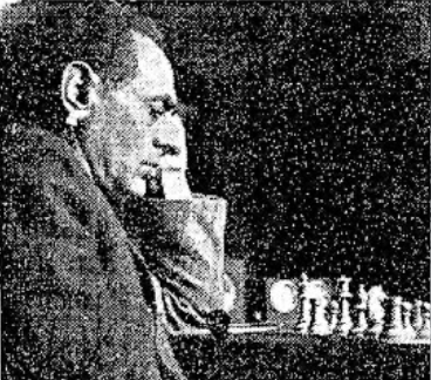
Ezra (Edward) Glass (Source: Davar newspaper, 4.1.1952)
He was imprisoned in 1938 in the Dachau concentration camp (winning the camp chess championship) and was forced to leave for the Shanghai ghetto in China. The Chinese authorities granted asylum to 20,000 Jewish refugees who had fled the Nazis in Europe. After the Anschluss, the Nazis in Austria adopted a policy of forced emigration of Jews, accompanied by humiliation and threats to their lives, and on the condition that they give up both their rights as citizens and all their property.
In Shanghai, the Jewish refugees survived the holocaust of World War II. Glass won, among other things, the Far Eastern chess championship. With the establishment of the State of Israel, Glass immigrated to Israel and became one of the strongest players in the country. He participated in the first chess championship of the State of Israel in 1951 and finished in third place (champion Dr. Menachem Oren).
Baron-Glass
Israeli Championship 1951
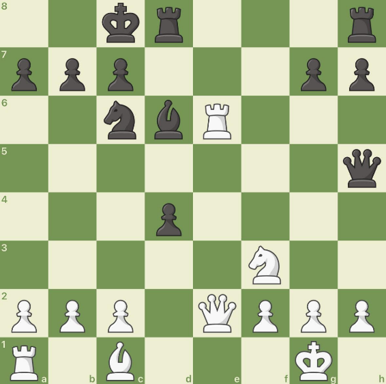
13…d3! 14.Qe4 Nd4! 15.Rxd6 Rxd6 16.Be3 Nxf3+ 17.gxf3 Re818.Qf4 Rg6+ 19.Kh1 Qh3 20.Rg1 dxc2 21.Rxg6 hxg6 22.Qc4 b5! and white resigned
After a few years he left Israel and returned to Vienna. He died in 1981 in Vienna at the age of 79.
Shimon (Siegmund) Beutum, 1890-1966
A player for the “HaKoah” Vienna and Austrian champion in 1926. He represented Austria at the 1928 Hague Olympics.
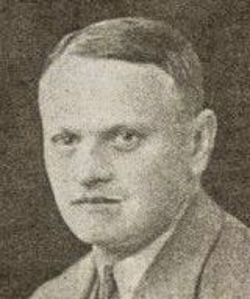
Shimon (Sigmund) Boitum (Source: website https://www.chessgames.com)
Boytom did not win first places in strong competitions, but “he was a dangerous opponent even for the great chess players. He gained a reputation as an excellent tactician and a man of sharp ideas” (Czerniak 1966).
B. Honlinger-Boytom
Vienna 1929
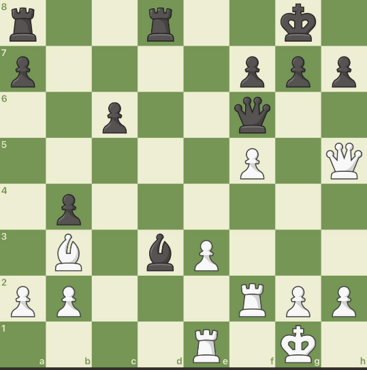
21…c5! 22.e4 c4 23.e5 Re8! 24.Ke1 Rad8 25.Rc1 Qh6 26.Rd1 cxb3 27.Rxd3 bxa2 28.Rf1 Qb6+ 29.Kh1 Qa5 30.Rxd8 Rxd8 31.Ra1 Qxe5 32.Qb3 Qd5! 33. Qxb4 Qd1+ 34.Qe1 Qxe1+ 35.Rxe1+ Kf8 36.h3 Rd2 37.Kh2 Rxb2 38. Ra1 Qe7 and White resigned after a few moves.
Boytom immigrated to Israel at the end of the Maccabiah and was one of the most prominent players of the Haifa Chess Club. He participated in the Second Israel Championship in 1937 in Jerusalem and finished in 6th place (the champion was Yosef Porat-Frader). He also participated in the strong Masters Tournament in 1952 and finished in 5th place (winner Dr. Menachem Oren).
He died in 1996 in Haifa at the age of 76.
International Chess Competition in Israel at the Second Maccabiah 1935
In 1935, the Second Maccabiah was held in Tel Aviv, including an international chess tournament. The organisers of the Maccabiah had another critical goal: to creatively enable the immigration of Jewish athletes to Israel, despite the British “White Paper” and the British Mandate ruling the country at the time. This was due to a “black cloud” that had hung over European Jewry since 1933, due to the rise of the Nazis led by Hitler to power in Germany. Thanks to the event, at the end of the Maccabiah Games, many athletes were able to remain in the country.
The participation of two “Hakoah” players from Vienna added an international touch to the Maccabiah chess competition, with Ezra Glass finishing in 4th-5th place, and Sigmund Boytum finishing in 7th-8th place.
These players were also joined by Akim Lewit, editor of the Viennese chess newspaper “Weiner Schach Zeitung”, who covered the competition daily. The winner of the competition was Master Moshe Blass.
The Anschluss – the annexation of Austria to Germany
On March 13, 1938, Austrian Jewry faced a tragic event: the “Anschluss” or annexation of Austria to Germany. This followed a “forced” referendum in favour of unification, accompanied by threats and violence from Germany and massive support from the Austrian Nazis. Following unification, the Austrian state was abolished, and it became a province of the German Reich, which was based on Nazi ideology.
From then on, Austrian Jews became victims of persecution, humiliation, and a deliberate immigration policy placing pressure on Jews to emigrate from the country while renouncing their property and dignity. Those who refused were sent to labour and extermination camps.
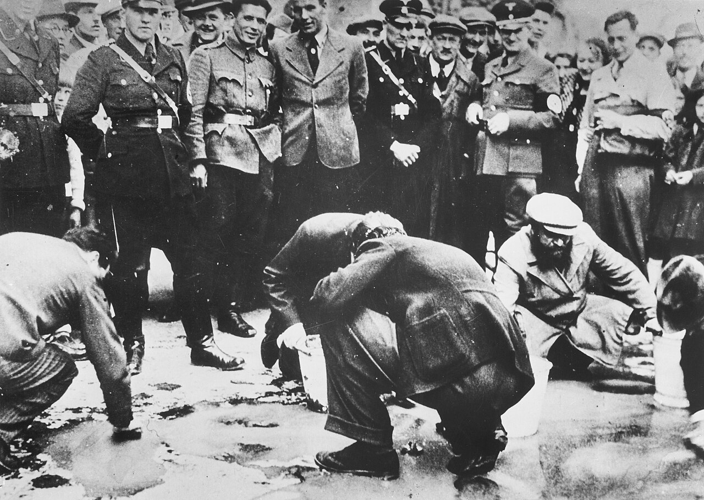
Austrian Nazis force Jews to scrub the sidewalks in Vienna, shortly after the Anschluss (1938). Source: United States Holocaust Memorial Museum
Before the Holocaust, Austrian Jewry numbered 185,000. Yet even before the Anschluss in 1938, anti-Semitism was rife in Austria, and, indeed, many Jews left the country. Of those who remained, 70,000 were murdered in the Holocaust. The Nazis outlawed all Jewish sports associations in Austria, banning Jewish chess players from playing in chess competitions, expelling them from visiting chess clubs, murdering Jewish chess players, and closing Jewish chess clubs in the country. The “Hakoah” Vienna club with 16 sports, which included 5,000 Jewish athletes, was shut down by the Nazis in 1938.
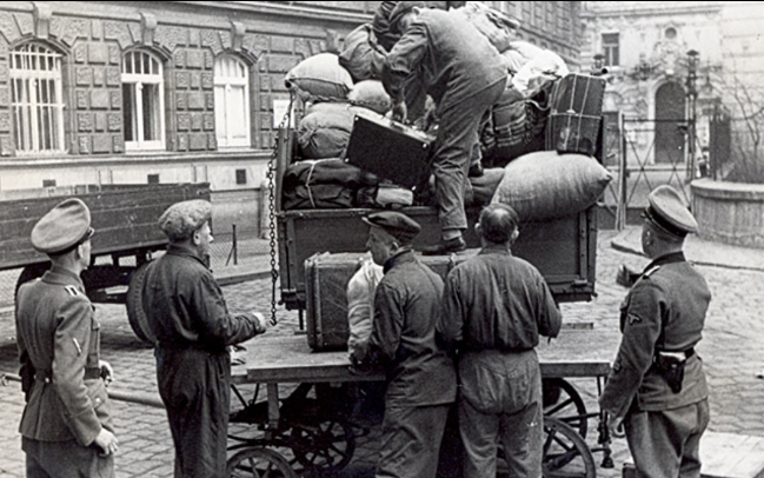
Holocaust of the Jews of Austria: Deportation of Jews from Vienna, 1942. Source: United States Holocaust Memorial Museum
“Hakoah” Club – From Vienna to Tel Aviv
In 1934, the Tel Aviv “Hakoah” football team was founded in Israel, based on the “Hakoah” Berlin team. This team also included players who had been forced to retire from European teams following the Anschluss and the rise of anti-Semitism in Europe.
The team played in the first league until the 1944/1945 season. In 1943, a football club called “Hakoah” Tel Aviv 1909 (named after the year in which Hakoah Vienna was founded) was founded by the ex-members of the “Hakoah” club in Vienna. In 1946, the two clubs were merged into one team called “Hakoah” Tel Aviv, which played in the minor league in football. Due to financial and organizational difficulties, the team merged again with Maccabi Ramat Gan in the 1958/1959 season.
This merged Hakoah-Maccabi Ramat Gan team became an empire, and played for 20 years in the National League at the “Gali Gil” field in Ramat Gan (near the pool). The team’s golden age was when it won the National League championship twice in 1965/1964, 1972/1973, and the State Cup twice in 1968/1969, 1970/1971.
At the same time, the “Hakoah” Tel Aviv club also operated a chess club, which was made up of talented chess players who had emmigrated from Austria, Germany (“Jackes”) and countries in Central Europe. Strong chess tournaments were held at the club and the club even registered for the chess league games that first opened in 1954.
“Hakoah” Tel Aviv was placed in the top league (A) and played in it for the first two years only, in the senior league. The historical composition of “Hakoah” Tel Aviv in its two years in the top league included, among others: Shlomo Smiltiner and Meir Rauch (both were players on the Israeli Olympic team), Weiler, Dov Wolfinger, Willi Mechner, Moshe Atidi, Helmut Foss, Yosef Herman, and Dr. Yosef Gottlieb.
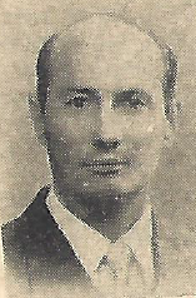
Shlomo Smiltiner
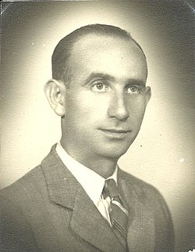
Meir Rauch
Final League A table 1954
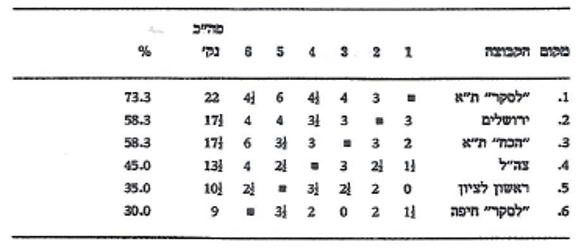
Final League A table 1955
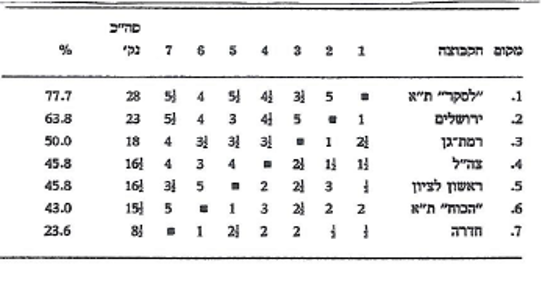
Starting in the 1956 season, the chess players of the “Hakoah” Tel Aviv team joined a new club “Reti” Tel Aviv (named after Richard Reti) that was founded at the same time and included senior chess players including: Israel Barev (Rabinovich), Dr. Yehuda Greengard, Rafi Persitz, and Zvi Zylberman.
Among the founders of the “Reti” club was Eliezer Peer (Ludwig Perlberger), also born in Vienna, who was a central figure in chess life in Israel and one of the founders of the Israeli Chess Association. Peer successfully managed the “Reti” Tel Aviv club for many years, and was even an active and enthusiastic chess player who played in chess competitions almost until his the day of his death. He died at the age of 102 (1915-2017).
The team played in the first league under the name “Reti” Tel Aviv from 1956 to 1968. In many seasons, the “Reti” Tel Aviv team was a top team, and even won the top league runners-up position (1956, 1957, 1960), with the alumni of “Hakoah” Tel Aviv contributing greatly to its success.
The league games in the years 1954-1961 were under the complete control of the champion “Lasker” Tel Aviv club (headed by Dr. Menachem Oren, Yitzhak Aloni, and Keniazer).
Summary
The story of the legendary sports club “Hakoah” Vienna, which perished in the Holocaust in Vienna and was resurrected in Tel Aviv, served as inspiration for Jewish sports clubs later founded around the world, all bearing the name “Hakoah” (Sydney, Buenos Aires, Copenhagen, and more).
In Vienna, too, attempts have been made in recent years by the Jewish community to re-establish the ” Hakoah” Vienna sports club, and it currently takes the form of a modest sports club.
The name ” Hakoah” is symbolic as part of the idea of restoring the crown of “muscle Judaism”, to provide a response to the feeling of humiliation and anti-Semitism experienced by world Jewry. When the Hakoach-Maccabi Ramat Gan team won the state soccer championship for the second time, in 1973, the idea behind the meaning of the name “Hakoah” was used to write the song “Hakoah is power,” sung by Zvika Pick, who was very connected to sports (the lyrics were written by Ilan Goldhirsch). The song became the champion’s anthem.
Those dark days in Europe during the Holocaust are, however, returning in these challenging times. Days accompanied by increasing and murky waves of active anti-Semitism against the Jewish people in various countries. It seems that the words of Professor Elie Wiesel (Nobel Peace Prize laureate 1986) regarding anti-Semitism have a deep meaning today: “I once thought that anti-Semitism was over. Today it is clear to me that unfortunately anti-Semitism will not end and will continue to exist. Because in various countries there is no shame in being anti-Semitic.”
The establishment of the sports teams of “Hakoah,” including “in sports of the mind” in the early years of the State of Israel, clearly illustrated the transition from the Holocaust to rebirth in the new state.
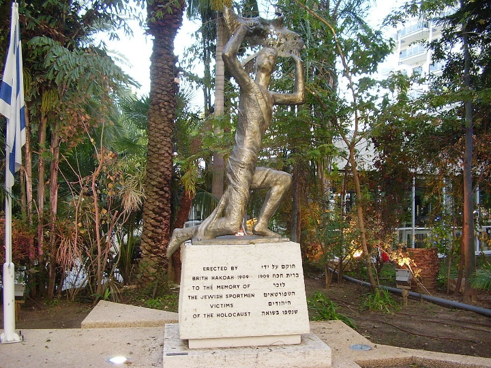
A monument in Kfar Maccabiah in memory of the Hakoah athletes who perished in the Holocaust (Photo: Dr. Avishai Teicher)