
By Assi Philosoph
Yesterday, the closed tournament witnessed a long yet stunning struggle between two young, promising players and friends: Azoulay and Zakin. White opened with his beloved Alapin variation of the Sicilian, achieving a development advantage.
FM Azoulay,Y (ISR) – FM Zakin,I (ISR)
5th round: Closed tournament Maccabiah 6.7.2026
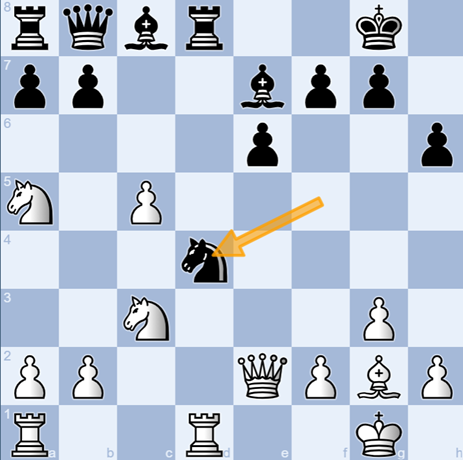
After 19…Nxd4 (diagram), White played a good move 20.Qc4 He could have taken the opportunity to make the first exchange sacrifice of the game: 20.Rxd4! Rxd4 21.c6 Rb4 22.Nd5! exd5 (22…Bf8 23.c7) 23.Qxe7 Rxb2 24.Qd8+ Kh7 25.c7 trapping the queen). If he had only known the course of the game, he would definitely have gone for it…
The game continued 20… Qc7 21.b4 Bf6 22.Ne4 e5 23. Nd6 Rb8 24. Bd5 b5 25. Qd3
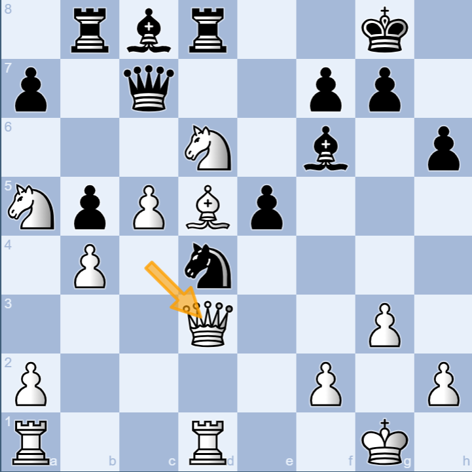
And, here, Black took his opportunity to sacrifice an exchange: 25… Rxd6! 26. cxd6 Qxd6 27.Be4 Bg4 A great practical decision, freeing his position, with a second white pawn about to fall.
28. f3 Qxb4 29. fxg4 29… Qxa5
Both players continued to make good moves, and, a few moves later, after 37.Bd5 (diagram), White is about to retake control of his position, since 38.g5 is a threat.
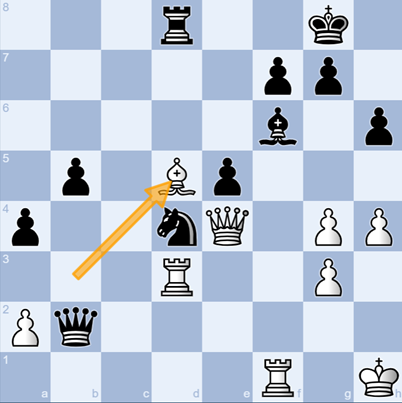
So… You already know the antidote, it’s time for another exchange sacrifice: 37… Rxd5!
38. Qxd5 Qe2 39. Rfd1 Qxg4 Black got another pawn for the second exchange, so it’s already 3 pawns for the double exchange. Black’s King is also much safer than White’s, and Black can potentially create a passer on the Queenside.
40. Qa8+ Kh7 41. Qg2 b4 42. Re1 42… g6 43. Rf1 Kg7 The position is much easier to play for Black, who has strengthened his position slowly. White defended well for many moves, but, understandably, his king’s position made long-term defense difficult, and his rooks have no way to create active play. Jumping on to move 51:
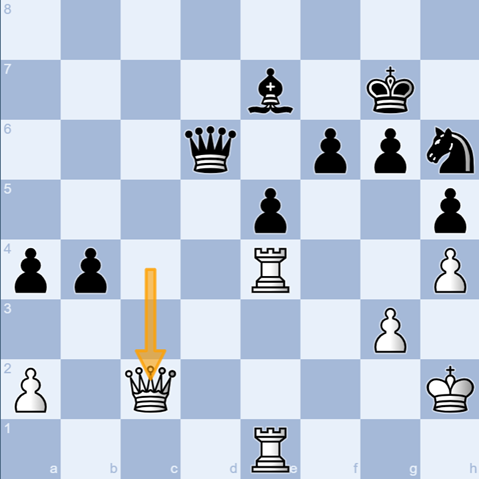
51… Ng4+ 52. Kg2 Qd5 53. Qc4 (53.Qc7 would have been best) 53… Qb7 54. Kf1 f5 and here White was already forced to give one exchange back, since the king is in danger, but now the remaining kingside pawns fall 55. Rxg4 Qf3+ 56. Kg1 hxg4 57. Qc7 Qxg3+ 58. Kf1 Qf4+ 59. Kg2 Qd2+ 60. Kf1 Qd6 61. Qb7 Kh6 62.Qc8 Bxh4 and Black went out to win a technical long game on move 109 and almost 6 hours of play!
This was an instructive game, illustrating the concept of exchange sacrifices: first on White’s attack, then later as a defense resource for Black, giving him control over the position and leaving White’s rooks without counterplay.
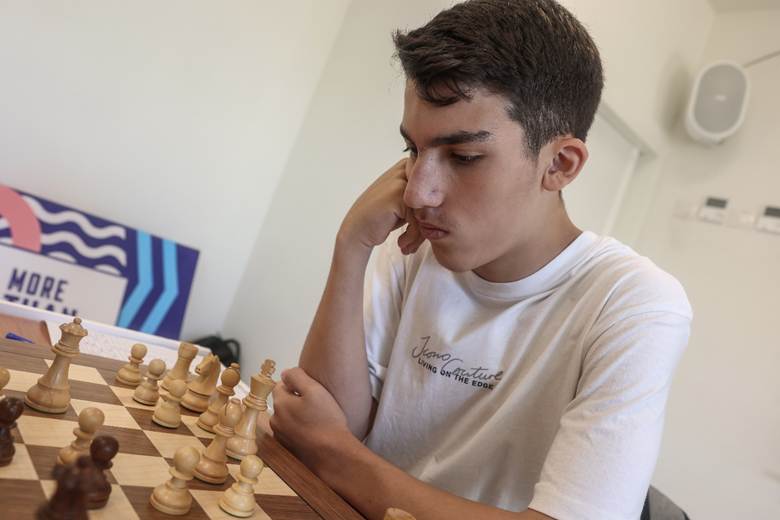
FM Ilay Zakin on his first Maccabiah | Photo: Mark Livshitz
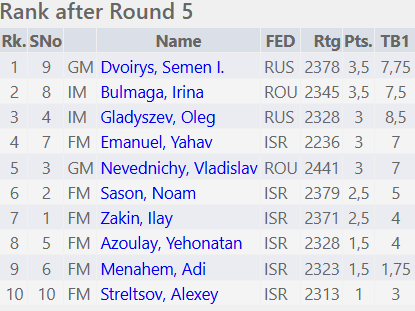
There were three more decisive games in the closed tournament. Nevednichy put early pressure on Streslov and went out to win. Gladyszev managed to create a nice attack in a seemingly quiet variation of the Ragozin. And Dvoirys won against Sasson, joining the lead with Bulmaga, who had a low-key draw against Emanuel.
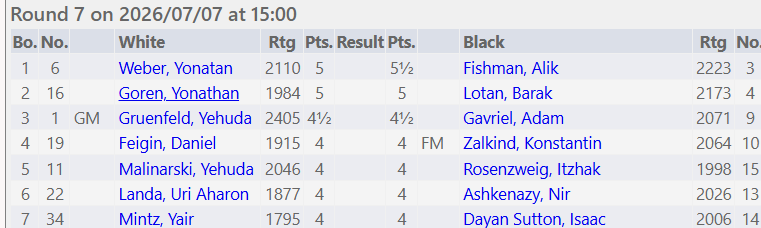
In the open section, the two highest rated lost in the 6th round: GM Gruenfeld to Fishman, and IM Zihzmer to Weber. Both winners will face each other in the 7th round. The fight for the medals is still open, with 3 rounds to go:
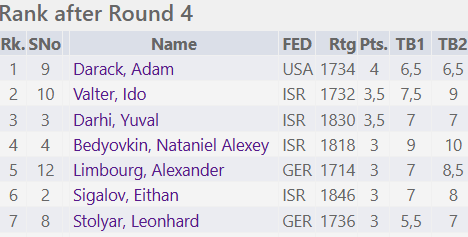
In the junior tournament, Adam Darack (USA) won on the first board with the black pieces, against Nataniel Bedyovkin (ISR), employing the risky Stonewall variation of the Dutch Defense. Darack is now the only player in all sections to have a score of 100%. Here is the top of the youth table, with 3 rounds to go:
xxx
Let’s not forget that this Maccabiah is being played simultaneously with the World Cup, and our players need to juggle their preparation for their games with watching their favourite national teams’ football games.
After the USA being eliminated tonight by Belgium, we are left with three competitors from countries still in the running for the World Cup: Gregory Elkiess (Switzerland), Jonathan Rubeck (England), and Gabriel Eisemberg (Argentina).
I had an enjoyable conversation with Gabriel, who told me about his story, his passion for chess, and his love for his two nations: Argentina and Israel. He also open heartedly shared his struggle against his disease, and how he keeps life going despite all the difficulties it brings. Here are his words:
“Hello, I’m Gabriel Eisenberg, I’m 20 years old. I made Alia from Argentina in 2020, right in the middle of the COVID-19 pandemic, together with my family, out of Zionist faith and our love for Israel.
Since I arrived, I have always tried to get involved in and contribute to the community. I founded the Chess Club at Ono Academic College, and during my studies I also organised social events so that students could get to know each other, build connections and strengthen their sense of community.
For me, chess is much more than passion: it’s an essential part of my life. I have a health problem that won’t let me run. When I was a kid in Argentina, the most popular sport was football, and it frustrated me a lot because I couldn’t play like the other kids.
And then my mother came up with the idea of teaching me chess. She explained that this is a sport in which everyone competes equally, without the impact of physical limitations. From that moment on, I fell in love with chess.
Chess has taught me that effort, discipline, strategy, and perseverance can open doors that often seem closed. It gave me self-confidence, a place where I could fully develop and a community to belong to. That’s why today I want to share the same feeling with others and continue to promote chess as a tool for inclusion, growth and personal development.”
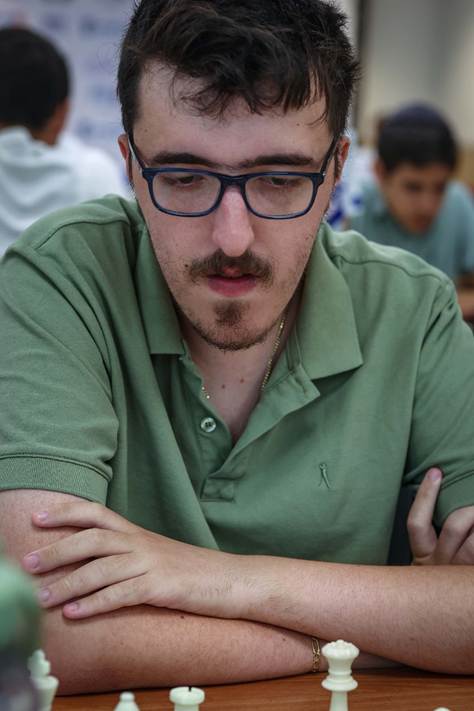
Gabriel playing on the 6th round of the Open Maccabiah | Photo: Mark Livshitz
Thank you, Gabriel, for sharing your story. We wish you good health and good luck with your chess project and studies. And of course, good luck to Argentina in the World Cup (although I shouldn’t say such a thing as a Brazil fan!).