
By Assi Philosoph
Grandmaster Yehuda Gruenfeld is the highest rated player competing in the 22th Maccabiah. At 70 years old, with a long, rich chess career, he is still fighting passionately on the board, and is a great source of inspiration for the Israeli chess community.
Gruenfeld has represented Israel in six Chess Olympiads (1978, 1980, 1982, 1984, 1990 and 1992) and was twice Israeli champion (1982 and 1990). He also played in the strong Interzonal tournaments twice, against the best players in the world (Riga 1979 and Zagreb 1987). On top of those achievements, he has won numerous medals in the deaf section and currently represents Ashdod Chess Club in the 1st Israeli League.
Shalom GM Yehuda Gruenfeld.
We were delighted to see your name on the list of participants in the 2026 Maccabiah.
This is a complex time for both Israel and Jewish people as a whole, and, unfortunately, many Jews from around the world will not be visiting this year’s tournament, after it was already postponed last year. Tell us how many Maccabiahs you have participated in, and about your achievements.
I have participated in a total of 4 Maccabiahs, the first in 1977 (in the team section), then 2009, 2013 and 2022 (in the invitational GM section).
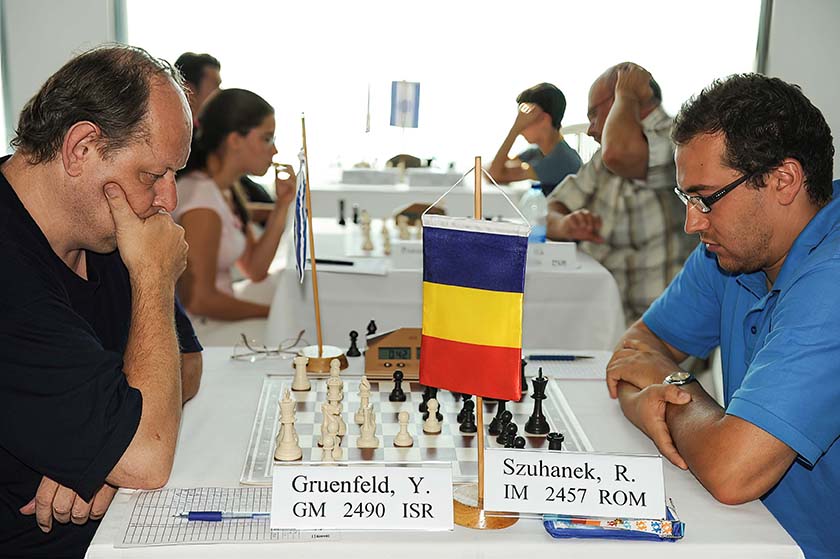
Gruenfeld against Szuhanek in the 18th Maccabiah, 2009 | Photo: Dr. Mark Livshitz
How do you see the importance of the event, given that your parents are Holocaust survivors, for Jewish people in general? Is this sporting event still relevant, even 78 years after the State of Israel was established?
The event is relevant today, all the more so because of the rising anti-Semitism in the world, and we must remind the world that we’re keeping our traditions and activities going, whilst at the same time hoping for a quieter future. As a Jew, Israeli, and Zionist, I’m proud to participate in an event in the world’s largest Jewish sport. We are here to stay!
You’re the second Israeli to win the title of Grandmaster, after Yair Kraidman. Tell us what you needed to do for that and how you felt after winning the unique title.
Honestly, I was hoping to be the first grandmaster in Israel! In 1976, the famous Jewish GM Najdorf from Argentina, during one of his frequent visits to Israel, came by the Lasker club in Tel Aviv, as usual, and the two of us played blitzes. After the games, Najdorf told people close to him that I would be a grandmaster. It definitely gave me a serious boost to move forward.
At that time, I invested a lot in training at home alone, with strong self-discipline. Back then, there were no computers and no internet, there were books, mostly Informants. Anyway, later that year, Kraidman became the first grandmaster in Israel, and with that my dream of being the first was dashed. But, of course, that didn’t stop me from chasing the high title.
I did it at the age of 24, and I was one of the youngest in the world to reach the title. In fact, at the age of 23, I was already close to achieving it. In the European Championship in Sweden, in the last round, I missed one simple move that would have given me an advantage with big chances to win against a Bulgarian grandmaster, but the game ended in a draw. Back in those days, you had to wait a long time (many months) for a tournament where you could get a score that counted towards becoming a GM, not like today when you can play tournament after tournament.
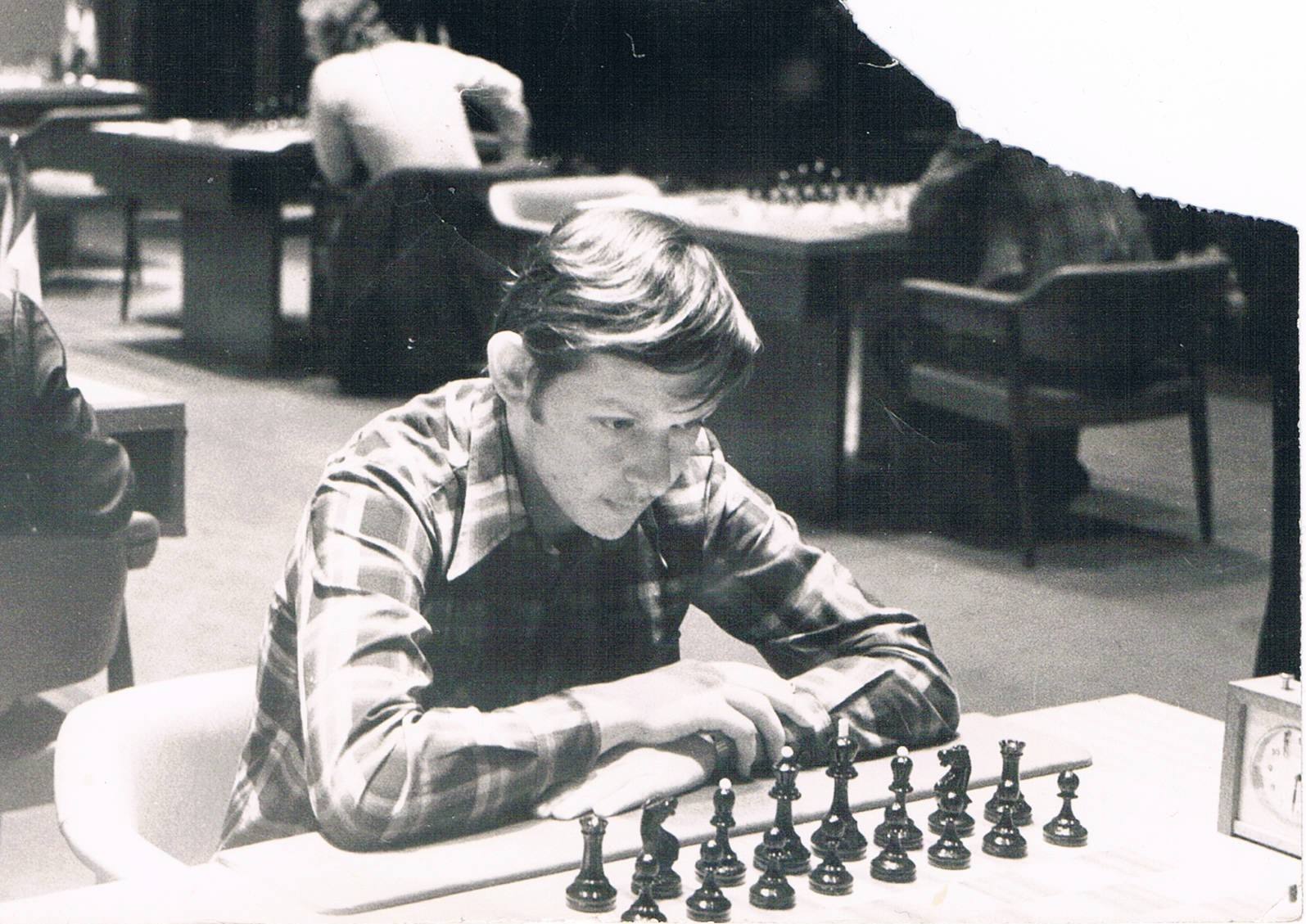
Interzonal tournament – Riga, 1979 | Photo: Courtesy of GM Gruenfeld
You participated in the Interzonal tournament twice. Tell us about the experience of playing alongside the best in the world. Did you feel big gaps in levels at the time?
The first time, in September 1979, was an extraordinary experience, as the tournament was held behind the Iron Curtain, in the USSR, which Israel had no diplomatic relations with. As expected, they made things very difficult for us right up until the last minute, when we (Shaul Greenberg, as a second, and I) received the visa at the USSR embassy in Vienna, just two hours before the flight. It was such a harsh welcome, and I thought that was what was waiting for us in the USSR.
In the morning, we flew to Riga with a number of other players from around the world, and when getting off the plane we were greeted by former world champion Mikhail Tal with his hearty smile. The atmosphere suddenly warmed up, and it also turned out that there were quite a few Jews in Riga, some of whom followed how the Israelis were doing in chess. As far as they were concerned, it was unusual for an Israeli to compete there and that contributed to the good feeling.
All I had to do was deal with all the big names. I was only 23 years old and the youngest participant (it was the same in the second Interzonal tournament in Brazil, in which the second Israeli representative, Shimon Kagan, participated) and lacked international experience. This was something I very much felt in the games: in contrast to me, the opponents were very experienced and most of them were world-renowned. But it was a reasonable debut, certainly in relation to any Israeli player.
In the tournament itself, Tal was at his peak, with 11 wins and 6 draws without a loss. Here I’d like to point out that my greatest experience in chess was Tal’s analysis. After every one of Tal’s games, people would rush to the analysis room to see the magician from Riga in action. He would replay his variants at a dizzying speed that was very difficult to keep up with. The variants were, of course, complicated for us ordinary players, but completely clear for him. Almost all his opponents, among them famous grandmasters, would sit quietly, and he alone would move the pieces, presenting sharp and imaginative variants which his opponents weren’t anywhere close to imagining. He was known as the fastest variant computer in the world. The one and only virtuoso. It’s no coincidence that Spassky cited him as the greatest player and that Fischer admired him like no one else.
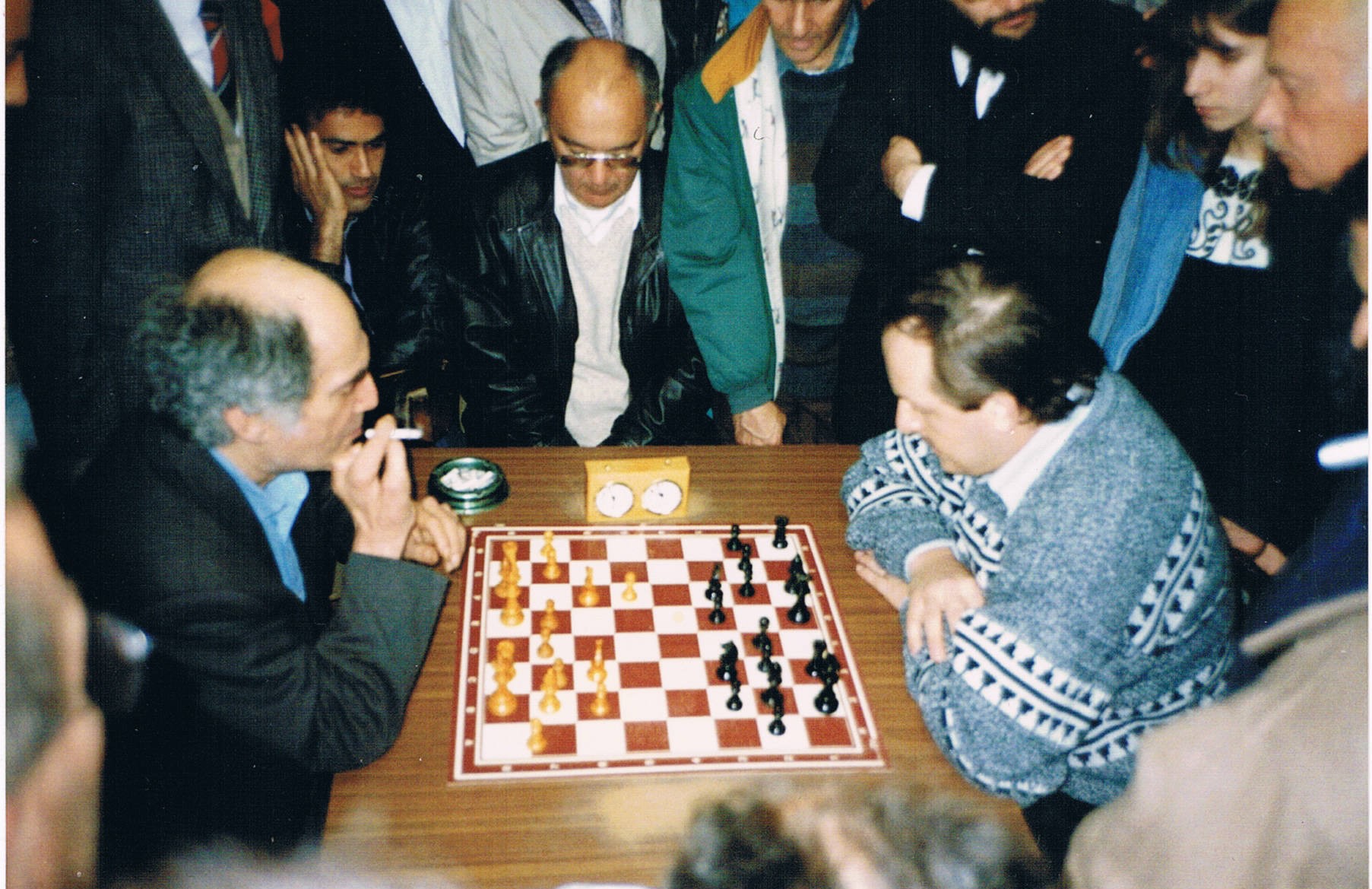
Blitz Tournament in Tel Aviv, 1990 against the magician | Photo: Courtesy of GM Gruenfeld
The second time was in the summer of 1987, the best time of my chess career: at my peak I was ranked 42nd in the world. I came to the tournament feeling very motivated, but also knowing that the obstacle of qualifying for Candidates would be very difficult. I got a good result, not enough to make it to the playoffs (it turned out that with just one different result, I could have qualified for them), but, overall, I came out satisfied with the tournament.
How did you train at that time? Did you train on your own or did you have a coach?
When I was young, after high school, I was already training on my own because there were no coaches at the level that exists today. There wasn’t yet such a big increase (in good players and coaches) as there was in the 90s, which brought a huge number of talented people to all fields, including chess. They were people who completely changed the face of chess in Israel. On graduating from high school, I won the Israeli Youth Championship and progress sped up.
Tell us about one special experience from one of the Olympics where you represented Israel.
There were many things I saw or experienced, but one I remember in particular was at the 1982 Olympics, in the USSR, against Switzerland. Kasparov on board 2 of the USSR team played with black against Viktor Korchnoi from Switzerland. The then world champion Karpov “gave up” the honor of playing against the Soviet “enemy of the people”. The game was fascinating from start to finish. A very complicated game in the Benoni defense. Kasparov played brilliantly, and not without risks.
Immediately after the game, Karpov, who had followed the game, told Kasparov that, at one point, he would have been in a difficult position if Korchnoi had been accurate. But that doesn’t detract from the great boldness which Kasparov showed in the game. Korchnoi himself said, after the game, that Kasparov showed great promise, and it was clear to everyone that we were witnessing the next world champion.
Your achievements in the World Deaf Championships are many, and you’ve brought many medals to Israel. How do you relate to these championships? Are your achievements in the section more significant than winning the Israeli main championship or representing Israel in the Olympics, for example? On a personal level, which achievements do you give more weight to?
On a professional level, I appreciate the Israeli championship, the Olympics, or achieving the title of grandmaster more, but that doesn’t detract from my achievements in the deaf section.
I represented the international deaf team 5 times in the regular Olympics (2010-2018). It was important to me to represent them mainly in terms of image, as, as a deaf person, I feel that our public image isn’t good enough, and that that needs to be corrected. But I don’t want to go into detail on that right now.
My achievements in the deaf events are certainly respectable. There were 3 deaf people who won their national championship: the first Boris Verlinsky, in Russia in 1929, Dolio Kollotis, in Italy in 2002, and me. I’m the only one who’s won twice, in 1982 and 1990.
That’s amazing!
What’s your attitude towards contemporary chess, which is analysed in depth with computers? How do you relate to the younger generation of chess players, and are you in favour of moving to Fischer Random Chess?
Computers have brought about a massive change in the perception of chess, from all directions, especially among the younger generation. Unfortunately, the collateral effect is how computers “hack” our lives. There is less creativity in chess than in the past, and I’m happy to see that the World Champion Gukesh from India is very creative, with very complicated variant calculations. His approach is the opposite of Carlsen and his ilk, who try to stay away from all kinds of branched variants that carry risk. Gukesh, on the other hand, goes into them with great joy.
He also adds a lot of interest in his games (let’s ignore the past year, which was terrible because of the results). In my opinion, out of a desire to earn as much as possible from tournaments, he’s dragged into rapid and blitz tournaments where he’s not a specialist like Carlsen, for example, and that’s where the results drop, and that hurts his self-confidence and puts unnecessary pressure on him.
Carlsen, at least until recently, is still the strongest player in the world, but his chess is unattractive and sometimes boring, which makes people think of alternatives to classical chess. I’m not enthusiastic about Fischer Random and hardly follow it. But whoever wants to play it is welcome. In Fischer Random, it’s almost impossible to prepare an opening (I assume that this is part of the idea, to get rid of openings altogether, which have become exhausting.), so for the theorists among us this is a problem.
Let’s go back to computers. As for the younger generation, there’s huge progress at their level, of course largely thanks to computers. And the younger generation have completely taken over world chess, as we saw recently in the Candidates tournament.
Tell us a little about your private life. Family, work, hobbies, etc.
I’m a widower, I have one son, and I retired from a job at Hagihon (Jerusalem’s water company) two and a half years ago. I keep myself busy in many fields: chess, computers (I learned programming a long time ago), I’m very interested in politics (the multitude of media channels allows you to filter out “background noise” from all the headlines on the various channels), but only from a distance, I won’t get into that quagmire. I travel here and there, even abroad.
Thank you very much for your time, and good luck at Maccabiah 2026 games!