By Assi Philosoph
It’s 10 o’clock in Herzliya Chess Club. The clocks starts the final round of the 22nd Maccabiah, and the room is in complete silence. You can hear the milkman on the street shouting “I’m leaving! It’s Shabbat”. Ok, not exactly, the milkman would have been more of a feature of the first Maccabiah, in 1932. But you could hear the cars outside… Ok, maybe not quite: they are electric these days. But anyway, you get the idea of the type silence I mean. The players are concentrated and ready to give it their best to get a shot at a Maccabiah medal, and to become part of history in the Jewish Olympic games. Let’s take a look at what happened:
Closed tournament
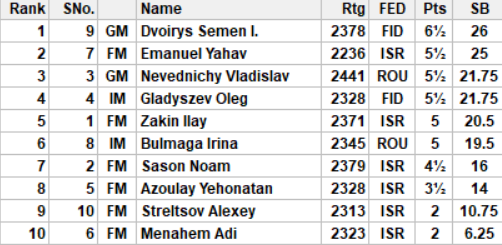
Dvoirys started the round as the leader (6 points), after a victory in the 8th round against Streslov. A draw was probably enough for him to finish first solo, as Nevednichy was half a point behind (5.5) with a worst tiebreak. After Dvoirys and Nevednichy, four players were ranked third before the last round with 4.5 points: Gladyszev, Emanuel, Zakin, and Bulmaga. All of them were still in the picture for the medals.
Zakin won a pawn against Semen Doirys (RUS), but it wasn’t enough to win against Dvoirys’ (RUS) strong defense, which helped secure him the gold medal with 6.5 out of 9, undefeated!
Bulmaga was close to losing against Sason but escaped with a draw. Gladyszev, on the other hand, managed to defeat Menahem. Yahav Emanuel (ISR) was the first to deal a loss to the Romanian grandmaster Nevednichy, after winning a double rook endgame against the queen. This result turned the table, allowing Emanuel to scoop the silver medal because of a better berger.
Vladislav Nevednichy (ROU) finished third and took the bronze medal, which was shared with Oleg Gladyszev (RUS), who received the same number of points.
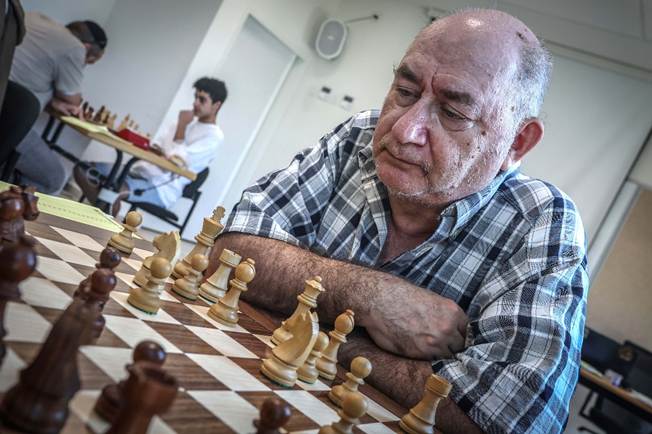
GM Semen Dvoirys – Gold medal and undefeated | Photo: Mark Livshitz
The final standings:
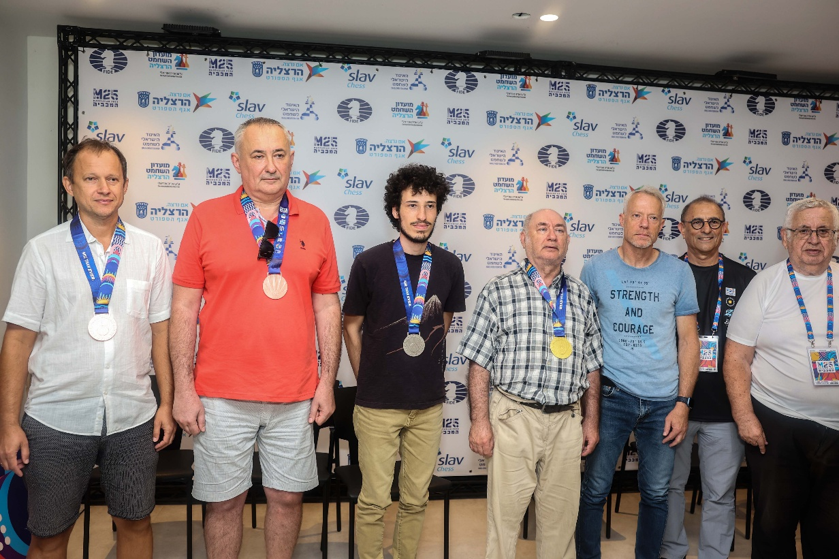
From left: Gladyszev, Nevednichy, Emanuel, Dvoirys, Bushinsky, Slav and Kandelshein | Photo: Mark Livshitz
Open Tournament
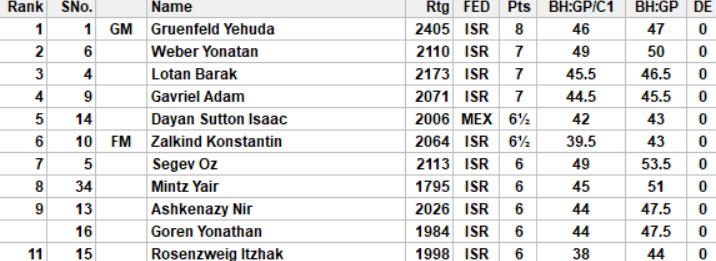
In the open section, GM Yehuda Gruenfeld (ISR) finished the last round with a draw against Lutan, with an impressive 8 points out of 9. This secured him the gold medal and confirmed him as the best player in the tournament. We all know the pressure a first-rated player faces in an open, having to prove themselves as the best.
The fight for the two other medals was exciting until the end. Lutan had to wait for the result on the second board, where Adam Gavriel, who had 6 points before the round, defeated Yonatan Weber (7 points), equaling the number of points of the two others. In the end, Yonatan Weber’s (ISR) Bucholtz was best, as he had played stronger opponents along the way, and he finished second with the silver medal. And Barak Lutan (ISR), with only a one-point tiebreak difference, took the bronze medal, meaning that Adam Gavriel (ISR) finished in respectable 4th place.
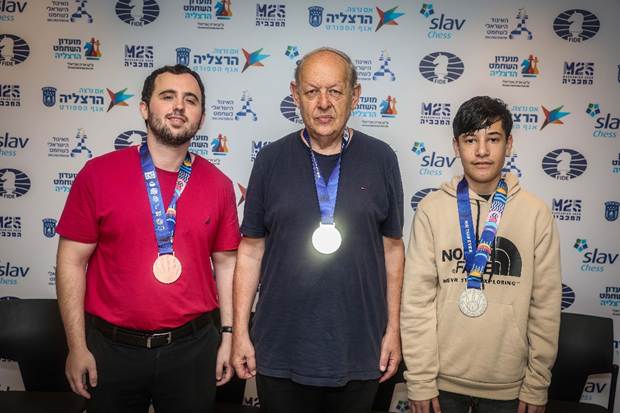
The winners (from left): Lutan, Gruenfeld and Weber |Photo: Mark Livshitz
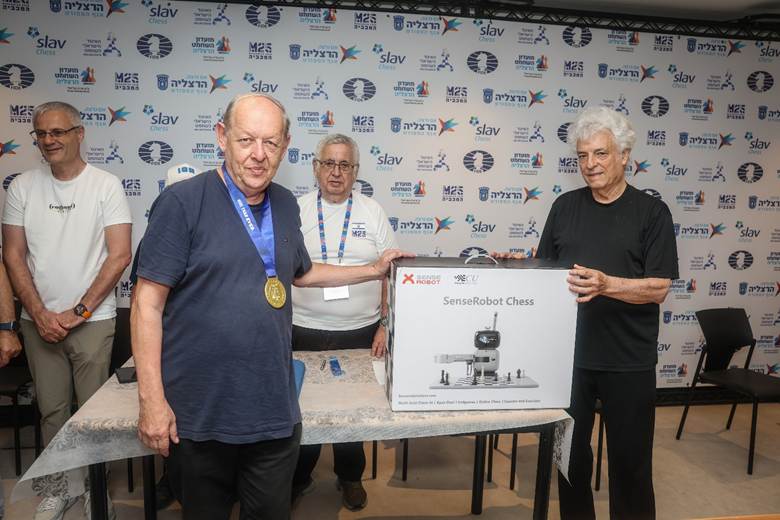
GM Gruenfeld with the special prize, presented by Mr. Gelfer |Photo: Mark Livshitz
The best foreigner player of the tournament was Isaac Dayan Sutton from Mexico, who finished in 5th place with 6.5 points, after winning in the last round against Itzhak Rosenzweig (ISR).
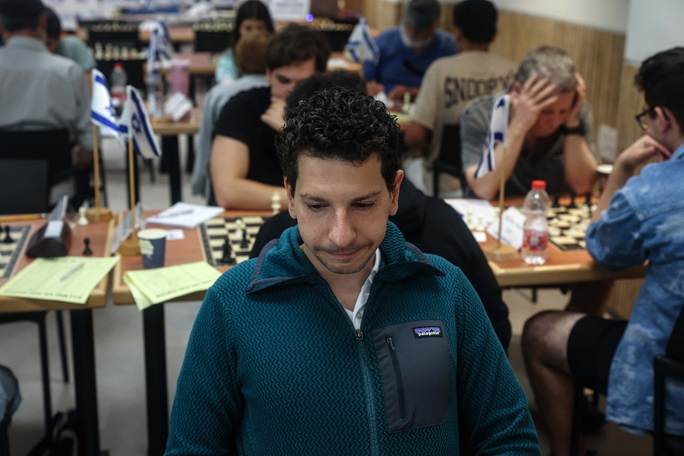
Isaac Dayan Sutton – best from the west |Photo: Mark Livshitz
Junior Tournament
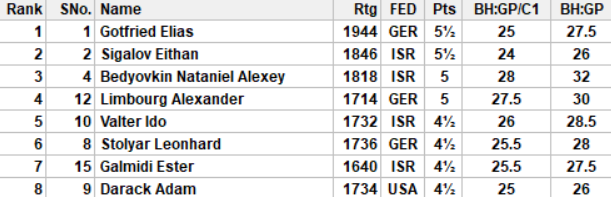
In the junior section, two decisive games on the first two boards decided the podium. Elias Gotfried (GER) defeated Ido Valter (ISR), securing the gold medal with 5.5 points. Despite also scoring 5.5 points, Eithan Sigalov (ISR) scooped the silver medal because of a Bucholtz tiebreaker. Sigalov defeated the leader Nataniel Alexey Bedyovkin (ISR), who took the bronze medal with 5 points.
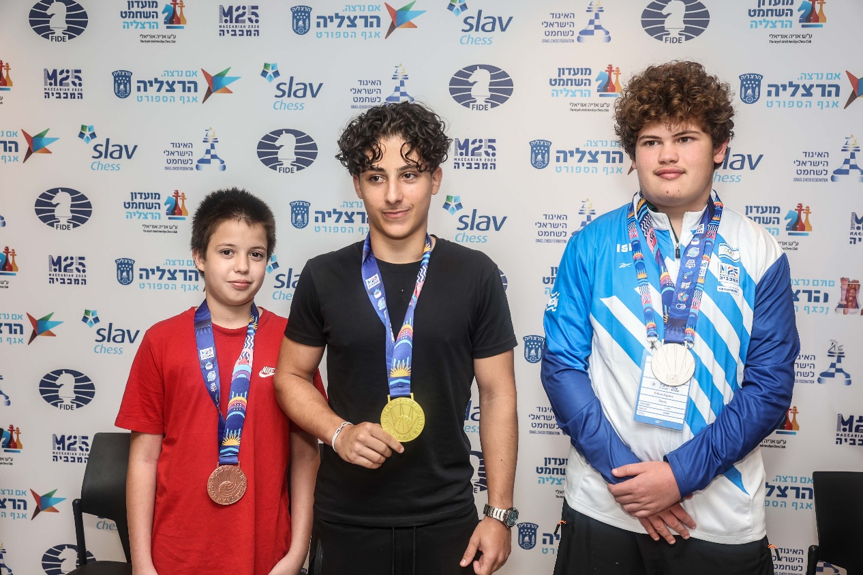
From left: Bedyovkin, Gottfried and Sigalov |Photo: Mark Livshitz
The closing ceremony was attended by Mr. Aviv Bushinsky, President of Heseg Foundation and former President of the Israeli Chess Federation, Mr. Assaf Stolarz – Sports Department Chairman of the Maccabiah, Mr. Gil Boruchovsky – CEO of the Israeli Chess Federation, Mr. Israel Gelfer – Head of the Anti-Cheating Committee, Dr. Shlomo Kandelshein – President of Herzliya Chess Club and Dr. Moshe Barzilai – Directory member of Hertzliya Chess Club.
The panel discussed the importance of the Maccabiah event, its heritage, and its connection to the diaspora. They also expressed their thanks and appreciation to all the participants, especially those attending from outside of Israel in these challenging times. As well as this, they praised Mr. Moshe Slav for his dedication to this event for the 11th time, and wished for many more to come.
Moshe Slav, Head of the Chess Macabbiah, thanked the organization staff: Dr. Shlomo Kandelshein (the host), IA Idan Lavi (Director and Chief arbiter of the Maccabiah tournaments), Binyamin Levy and Itzhak Zaken (the arbiters), Mark Livshitz (the photographer), and Assi Philosoph (the writer). They all did a great job: Kol hakavod!
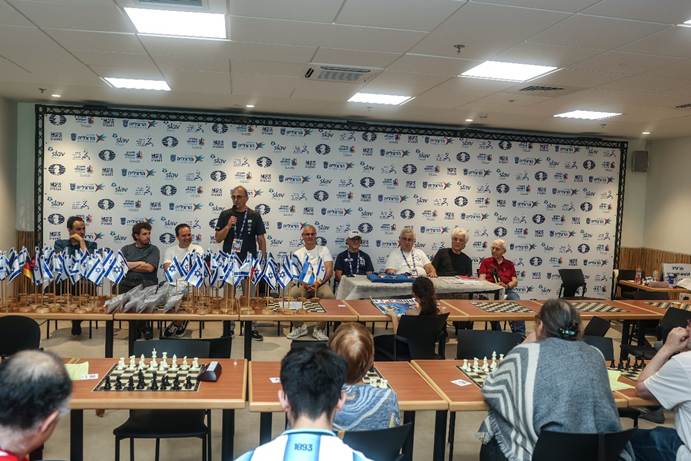
From left: Philosoph, Levy, Lavi, Slav, Boruchovsky, Stolarz, Kandelshein, Gelfer and Barzilai | Photo: Mark Livshitz
xxx
After the tournament, I had the pleasure of chatting with Aaron Krayn, a player representing the USA in the junior section. He took the time to openly write about his feelings about Israel, being Jewish, and chess. Here are his words:
“For most of my life, I have been a chess player. For my entire life, meanwhile, I have been a New Yorker and a Jew. For almost a decade, these three parts of my life flowed seamlessly. At 6 and 7 (pun intended), I raced to local and national events as a top player at a well-known Jewish school. I never considered which parts of my identity to share and which to hide. As are most things in hindsight, life was simple. As my chess career progressed into middle school, I transitioned to a secular preparatory high school in Westchester, a suburb of New York. For the first time, I considered what it meant to be Jewish. While I wasn’t alone in my Jewish heritage, I was certainly different from the average student. At the same time, I was introduced to suburban life – big homes, calmer lifestyle, and soccer moms. Even more, at my new school, I was far from the best chess player, a sharp contrast from the life I previously claimed. I began to question. What makes New York City so special? How can I be Jewish in such a foreign environment? Is chess worth continuing if I’m not even the strongest player at school?
A few years later, on the way to a soccer tournament (yes, despite what you may think, chess players do in fact go outside on occasion) on October 8th, my father told me of a tragic terrorist attack in Israel that had occurred overnight. For a while, I did not understand the gravity of the situation. After all, attacks such as these seemed to happen constantly, and I didn’t see the difference. Of course, with time, I quickly grew to comprehend the events that took place that day.
Following the atrocities committed on October 7th, I, like many Jews, developed a stronger affinity for my religion and culture, and Israel. When I went to chess tournaments, I started thinking about what I put out into the world as a Jew. Am I a good representation of my people? Am I keeping myself safe in the ways I express my Judaism?
Watching the news unfold, with ongoing war, American university encampments, such as the ones just a few blocks north of my home at Columbia, and online debates, I tried to find ways to be more connected with Jews. I joined Jewish programs and fellowships, hoping not only to connect with my peers, but to learn something too.
As time went on, my chess did too. In the back of my mind, I often thought about the Maccabiah Games and the possibility of me playing in them one day. I had heard legends about the games, whether from my parents or my chess coach, who had previously represented England. At my new school, with so many strong chess players, I always kept this dream down, knowing I wouldn’t be good enough. Yet, one day, without my asking, my dad looked into joining the team and surprised me, explaining that not only could I play as a Junior in the 2025 Maccabiah, but I would be a reasonable fit (in terms of skill level) too. For the first time in a long time, I felt adequate as a chess player.
I arrived in Israel with a dream – winning a medal. Walking into the Herzliya Chess Club, I was astonished. I had an American flag next to my board; there were players from all over the world, and the overall atmosphere was that of a serious international event. After just a few games, it became clear that my dream would not be fulfilled. Frankly, I played terribly. But for the first time, it was okay. The experience of representing my nation at a Jewish event, with a team of Jews, in the Jewish homeland was enough.”
Aaron’s words bring home what a strong community we have over the world, and how important this event is as a connection between the Jewish diaspora and Israeli communities. It’s not only a chance to share our feelings about the tragic times we are living through, but also a way to spend time together in positive activities, like playing chess, and to think about a better future.
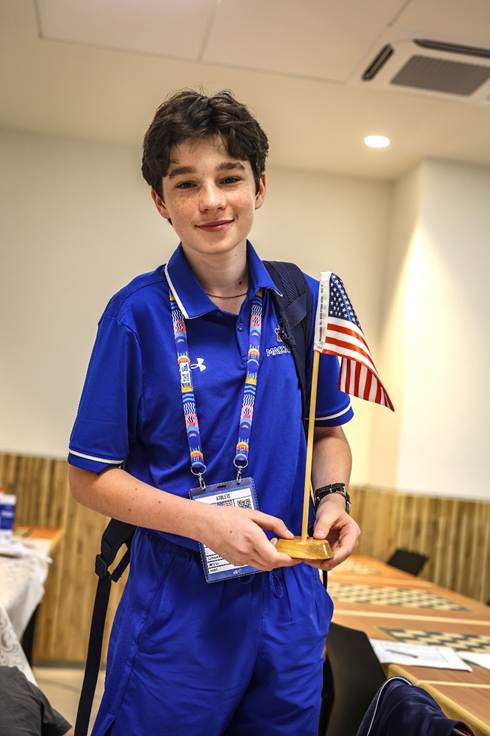
Aaron Krayn – Proud to represent the USA in the Maccabiah | Photo: Mark Livshitz
To conclude this year’s event, we present a lovely finish from a game played by another member of the USA delegation, Adam Darack, in his win over the bronze medal winner and leader of the junior tournament until the last round, Nataniel Bedyovkin.
Bedyovkin, N (ISR) – Darack ,A (USA)
4th round: Junior tournament Maccabiah 6.7.2026
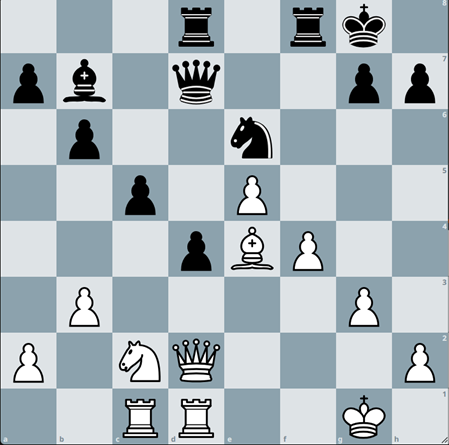
White played 26.Qd3, which allows for a nice tactical trick:
26…c4! Now, if 26.bxc4 Nc5, if 26.Qf3 Ng5 and if 26.Bxh7 Kh8 27.bxc4 Qc6 with a decisive infiltration.
The game continued 27. Qxc4 Bxe4 28. Nxd4 Bd5 29. Qb4 Nxf4! 30. gxf4 Qg4+ 31. Kf2 Rxf4+ 32. Ke3 Rf3+ 33. Kd2 Qg2+ 34. Ne2 Be4+ 0-1
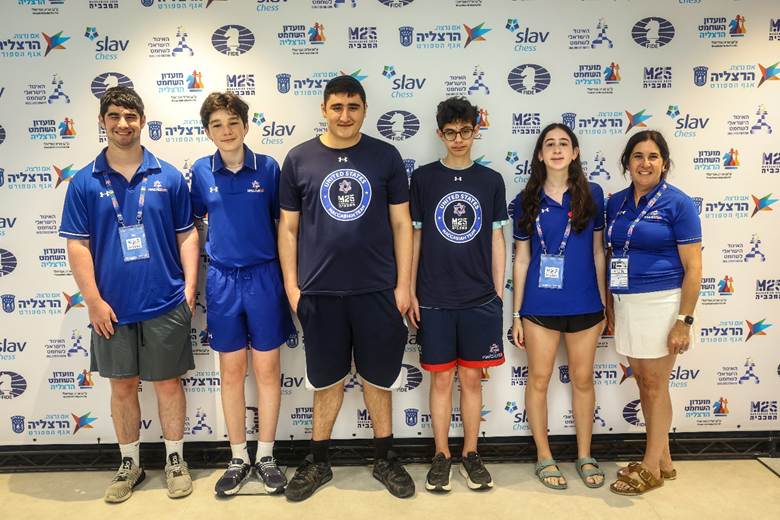
USA Delegation (from left): Levy, Krayn, Darack, Sussman, Black-Diamond and Rosenberg (Coach) | Photo: Mark Livshitz
See you all in the next Maccabiah, and we hope that players from as many countries as possible will attend!